 Car Service Land Coupons for Oil change, Tires, Wheel alignment, Brakes, Maintenance
Last updated: June 13, 2026 | By: Jake Morrison
June 2026 update: brake pad replacement pricing verified at major chains.
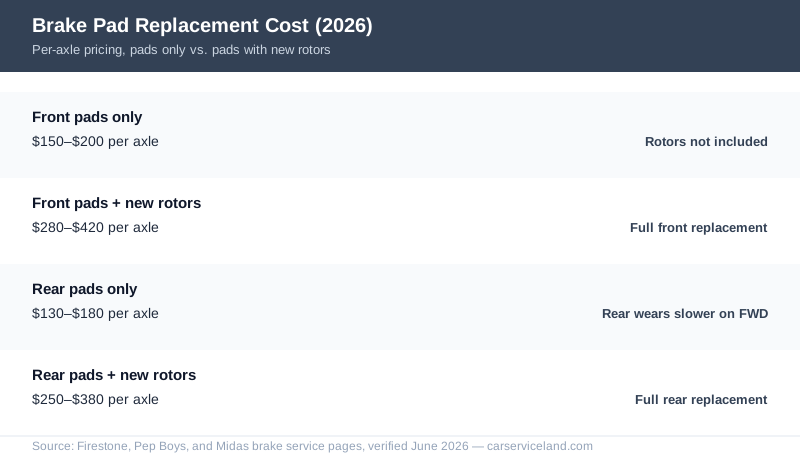
Brake pad replacement costs: $150-$200 per axle for front pads only, $130-$180 for rear pads only. Add rotors and the bill runs $280-$420 per axle for the front, $250-$380 for the rear. Prices are per axle – covering both wheels on one end of the car – and vary by vehicle, chain, and market. Firestone, Pep Boys, Midas, and Meineke all offer brake pad replacement. For a chain-specific breakdown, see the Firestone brake service cost and Pep Boys brake service cost guides.
Brake jobs are the service category where I see the biggest spread between shops on the same vehicle – sometimes $150 between a low quote and a high quote for identical work. Part of that is parts quality (there’s a real difference between economy and premium pad compounds), and part is labor rate. But a significant portion is just pricing strategy. Getting two or three quotes before authorizing brake work is not paranoia – it’s basic price comparison on a service that’s expensive enough to make the comparison worth the effort.
From my time at Jiffy Lube – which doesn’t do brakes, for the record – I saw plenty of customers come in with brake concerns and have to be redirected to shops that handle it. The ones who did best were the ones who called two or three shops with their vehicle info, asked for a brake inspection, and compared not just price but what was included in the quote. The ones who did worst went to the first shop that had them in and authorized a full four-wheel brake job without a second opinion. Sometimes that was the right call. Sometimes it wasn’t.
Brake Pad Replacement Cost by Service Type
| Service | Typical Cost Range | Notes |
|---|---|---|
| Front brake pads only | $150-$200 per axle | Both front wheels; resurfacing or new rotors not included |
| Front pads + new rotors | $280-$420 per axle | Full front brake replacement; most common repair on higher-mileage vehicles |
| Rear brake pads only | $130-$180 per axle | Rear pads wear more slowly on most front-wheel-drive vehicles |
| Rear pads + new rotors | $250-$380 per axle | Full rear brake replacement |
| Full four-wheel brake job (pads + rotors) | $600-$900 total | All four corners; often done on vehicles with worn brakes across all four wheels |
| Economy vs premium pads | $20-$100 price difference | Premium ceramic or semi-metallic pads cost more but reduce dust, noise, and rotor wear |
Do You Need Rotors or Just Pads?
Rotors don’t automatically need replacing every time you do brake pads. Whether rotors need to be replaced or can be resurfaced (machined down to a smooth surface) depends on their current thickness. Every rotor has a minimum thickness specification stamped on it – if the rotor measures above that minimum and the surface can be machined smooth, resurfacing is a legitimate option that saves $50-$100 per axle. If the rotor is at or below minimum thickness, or has deep grooves or cracks, replacement is the only safe choice.
Many shops now default to replacement rather than resurfacing because new economy rotors are cheap and resurfacing labor can cost nearly as much as a new budget rotor. Asking the shop to show you the rotor measurement before authorizing replacement is a reasonable request on any brake job. A shop that can’t or won’t show you the measurement is one I’d be skeptical of. For current rotor and pad pricing across the major brake chains in your market, the brake service prices near you gives you the baseline numbers to compare against before any quote.
Why Front Brakes Wear Faster Than Rear
Front brakes do the majority of stopping work on most vehicles – especially front-wheel-drive cars, where the front axle handles steering, acceleration, and most braking simultaneously. The weight transfer during braking shifts load onto the front tires, which means front brakes work harder with each stop. On a typical front-wheel-drive vehicle, front pads may need replacement at 30,000-40,000 miles while rear pads are still at 50-60% life. Rear-wheel-drive and all-wheel-drive vehicles share braking load more evenly, so the front/rear wear gap is smaller – but front pads still typically wear first on most vehicles. For a detailed breakdown of what determines pad longevity by driving type and vehicle class, the how long do brake pads last guide covers the full range of variables.
What Most Drivers Get Wrong About Brake Pad Replacement
The most expensive mistake is waiting until the metal grinding sound appears before getting brakes inspected. By the time metal-on-metal contact produces the grinding sound, the pad material is gone and the metal backing plate is contacting the rotor directly. This ruins rotors that might have been salvageable at an earlier inspection. A pad replacement that could have been $160 becomes a pad-plus-rotor job at $350+, because the driver waited for an obvious symptom instead of having brakes inspected annually. And if it’s been a while since you had an alignment check too, the alignment cost breakdown covers what that inspection runs – brakes and alignment are often best handled at the same visit. The squealing warning sound (a wear indicator designed into most pads) comes before the grinding – if you hear squealing on braking, that’s the pad’s built-in signal to schedule service.
The second mistake is assuming that a higher quote means better work, or that a lower quote means corner-cutting. The quote variance in brake jobs is real, but it’s often driven by parts tier – an economy pad set vs. a premium ceramic set – rather than labor quality. Get at least two quotes and ask each shop specifically what pad brand and compound they’re installing. A shop quoting $180 with premium pads and a shop quoting $160 with economy pads aren’t directly comparable until you know what’s in each price.
Frequently Asked Questions
How much should brake pads cost at Firestone or Midas?
Front brake pads at Firestone or Midas typically run $150-$200 per axle for pads only, or $280-$400 per axle when new rotors are included. Both chains use tiered pad options – economy, standard, and premium – which affect the quoted price. Ask which tier is included in any quote before comparing numbers between shops.
How long do brake pads last before replacement?
Most brake pads last 30,000-70,000 miles depending on driving style, vehicle weight, and pad compound. Aggressive city driving with frequent hard stops wears pads significantly faster than steady highway driving. Having brakes inspected annually or whenever tires are rotated is the most practical way to catch wear before it becomes a rotor-damaging situation. The best place for tire rotation guide covers which chains include a brake inspection as part of the rotation visit – useful for combining both checks without an extra trip.
Can I replace brake pads myself to save money?
Yes – brake pad replacement is within the capability of a driver with basic mechanical aptitude and the right tools. Economy pad sets for common vehicles run $30-$80 for the front axle, versus $150-$200 at a shop. The trade-off is time, tools, and the critical safety nature of brake components. Any DIY brake job should be followed by bedding in the new pads with several moderate stops before hard braking, and the vehicle should be test-driven carefully before normal use. If there’s any uncertainty about the procedure, professional installation is the right call.
What’s the difference between economy and premium brake pads?
Economy (organic or low-metallic) pads are quieter and gentle on rotors but wear faster – typically 20,000-35,000 miles. Semi-metallic pads offer strong stopping power and durability (30,000-60,000 miles) but can be noisier. Premium ceramic pads produce minimal dust, very little noise, and are gentler on rotors – lasting 50,000-70,000 miles in most applications, at a cost of $40-$80 more per axle than economy options. For daily drivers, ceramic or semi-metallic premium pads are usually worth the premium over economy choices.
Why do front brake pads usually cost more to replace than rear pads?
Mostly parts, not labor. Front brake systems on most vehicles use bigger calipers and thicker pad packages since the front axle absorbs the majority of stopping force, and those larger pads run $10-$25 more per axle than the rear set before any labor is added. Labor time is close to identical front to back – same caliper bolts, same basic procedure – so a shop quoting $180 for front and $150 for rear on the same visit isn’t padding the bill, that’s the parts cost showing through. The gap narrows on rear-wheel-drive and all-wheel-drive vehicles, where braking load is shared more evenly across both axles.
Is it normal for new brake pads to squeak for the first few days after installation?
Yes, within reason. A light squeal under gentle braking right after a pad job is usually the anti-squeal shims and new pad surface bedding into the rotor face, and it typically fades within the first 100-300 miles of normal driving. What’s not normal is a grinding sound, a squeal that gets worse instead of better, or noise under hard braking – any of those means something was installed wrong or a part is defective, and it’s worth going back to the shop rather than waiting it out. I tell people to drive normally for the first few days and pay attention to the trend, not any single stop.
My dashboard brake pad warning light came on – do I need to replace pads immediately?
Soon, not necessarily that day. Most pad wear sensor lights trigger when a pad’s built-in wear indicator contacts the rotor at a set thickness, which usually still leaves a few hundred to low-thousands of miles before the pad is fully gone – but that buffer shrinks fast with city driving and hard stops. Treat the light as a window to schedule an inspection within a week or two, not an emergency unless it’s paired with a grinding sound or a soft, longer brake pedal. Waiting months on an active warning light is how a $160 pad-only job turns into a $350 pad-and-rotor job.
Sources
Pricing from official Firestone, Pep Boys, Midas, and Meineke brake service pages, June 2026.

About the Author
Jake Morrison
Jake spent three years working the pit at a Jiffy Lube in Garland, Texas before switching to full-time automotive writing. He has personally used Walmart, Valvoline, Firestone, Midas, Meineke, and Jiffy Lube – and driven everything from a beat-up ’98 Civic to his current 2021 RAM 1500 5.7L Hemi. At carserviceland.com he covers what chains actually charge versus what they advertise.