 Car Service Land Coupons for Oil change, Tires, Wheel alignment, Brakes, Maintenance
Last updated: June 22, 2026 | By: Jake Morrison
June 2026 update: re-confirmed Midas and Walmart’s typical total visit times for an oil change.
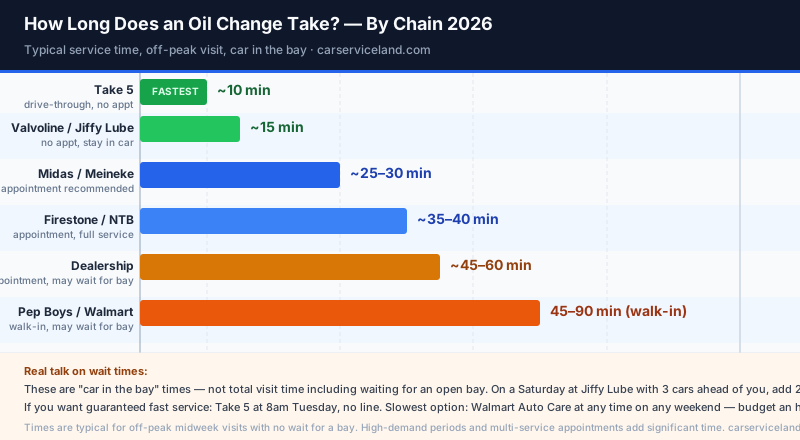
The oil change itself: 15-20 minutes. Your total time on site: 20-50 minutes depending on the chain and time of day. Take 5 is fastest (~10-15 min total). Jiffy Lube and Valvoline advertise ~15 min but often run longer. Walmart can take 45-90 minutes on weekends.
I spent three years doing oil changes at Jiffy Lube in Garland and here’s what I can tell you: the service itself is fast. Always was. The variable was never the oil change – it was the queue in front of you, the inspection conversation, and whether your truck needed 8 quarts instead of 5. An F-150 with a 5.0 takes longer than a Civic just because there’s more oil to drain and fill. That’s still true today at every chain, just with fancier timing boards. When a shop advertises “15-minute oil change,” they’re quoting wrench time, not door-to-door time. These are not the same number on a Saturday morning.
Current Oil Change Time Estimates by Chain
| Chain | Advertised service time | Realistic total visit | Model |
|---|---|---|---|
| Take 5 | ~10 minutes | 15-30 min (off-peak); 30-60 min (weekend) | Drive-through, stay in car |
| Valvoline | ~15 minutes | 20-35 min (off-peak); 35-60 min (weekend) | Stay in car, no appointment |
| Jiffy Lube | 15 minutes or less | 20-40 min depending on queue | Walk-in, standard service bay |
| Midas | ~60 minutes | 60-90 min | Service center with inspection included |
| Walmart | No speed guarantee | 45-90 min | Schedule-oriented service bay |
Service times from official chain pages, June 2026. Total visit time includes queue time and will vary by location and time of day.
The Service Time vs. Total Time Distinction
When a chain says “10 minutes” or “15 minutes or less,” that’s describing how long the service takes once your car is in the bay. It is not a guarantee that you’ll be in and out the door in that time. If there are three cars ahead of you in the queue – which is routine on Saturday mornings – you’re waiting through those services first.
This isn’t false advertising. It’s just a fact of the walk-in model that most people don’t account for until they’re sitting in the parking lot. Go mid-morning on a weekday and the advertised service time is usually close to your total time. Go Saturday at 10am and double it.
Quick-Lube Chains: Fast Once It Starts
Take 5 is the fastest of the group at ~10 minutes. Their whole operational model is built around a drive-through that keeps moving. The service includes oil and filter change, manufacturer spec check, fluid top-offs, tire pressure, and multi-point inspection – all in that 10-minute window. If you’ve never used Take 5 on a quiet Tuesday morning, the speed is actually impressive. For current Take 5 pricing and coupons, the Take 5 oil change coupons guide has what’s currently active.
Valvoline and Jiffy Lube both market ~15 minutes. In my experience the Valvoline stay-in-car model is particularly smooth when the location isn’t slammed – the techs work from multiple angles simultaneously and the communication while you’re in the car makes the visit feel shorter than it is. Jiffy Lube is similar, though the experience varies more by location quality than the other two. For current Jiffy Lube pricing by oil type, the Jiffy Lube oil change price guide has the detail.
Service Centers: Slower, Different Purpose
Midas is honest about the timing: about 60 minutes. That’s because a Midas oil change includes the full Closer Look Vehicle Check – brakes, battery, belts, hoses – which adds real time but also real value. If you’re going to Midas primarily for the oil change, that’s the wrong chain. If you want the oil change plus a documented inspection of your vehicle’s condition, the hour is worth it. The Midas oil change coupons guide shows what local pricing actually looks like before you go.
Walmart is the most variable. Their Auto Care Centers don’t promise quick-lube speeds and push scheduling ahead of time. When they’re busy, waits can stretch to 90 minutes or more. For a $28.88 conventional oil change, that’s a lot of your day. The math changes if you’re already doing other shopping in the store while you wait.
When to Go for the Shortest Wait
Time of day matters more than which chain you pick. Here’s what I’ve consistently found holds true across locations:
- Best time: Tuesday-Thursday, 10am-noon. The weekend rush is over and the lunch crowd hasn’t arrived.
- Second best: Right when the shop opens on weekdays. You’ll often be first in queue.
- Avoid: Saturday morning (busiest period system-wide). Friday afternoons also tend to back up as people fit in errands before the weekend.
- Worst: Saturday between 9am-1pm. Every quick-lube in America gets hammered during this window.
What Most Drivers Get Wrong About Oil Change Wait Times
The advertised service time is not your total time on site – and most people confuse the two until they’re sitting in the parking lot. “15 minutes or less” means wrench time: from when the car goes in the bay to when it comes out. If there are two cars in front of you, you’re waiting through 30 minutes of service before your 15-minute clock even starts. I saw this every Saturday at Jiffy Lube in Garland. People would show up at 10am expecting to be done in 20 minutes and leave 55 minutes later, frustrated – not because anything went wrong, but because the queue was three deep and nobody told them the advertised time was service time, not door-to-door time.
The fix is easy: go on a weekday morning or check the queue ahead of time (Valvoline’s local pages sometimes show live wait estimates). Saturday morning is when this confusion stings the hardest. If no-appointment speed is a priority, the best place to get an oil change without an appointment guide ranks the chains by total visit efficiency.
Jake’s Take
10-15 minutes at Take 5 or Valvoline on a slow Tuesday. 45-90 minutes at Walmart or a full-service shop on Saturday morning. Those are the actual ranges. The service itself doesn’t take long – it’s the queue that gets you. If time is the constraint, go to a quick-lube chain on a weekday before noon, not a weekend. If you’re heading to Walmart or Firestone, check their online wait time display before you leave the house. Saving $5 on the oil change isn’t worth sitting in a waiting room for 90 minutes when you had other plans.
Frequently Asked Questions
Can an oil change really take 10-15 minutes?
Yes – the actual service, once your car is in the bay, really does take about 10-15 minutes at a quick-lube chain. I timed plenty of these myself back at Jiffy Lube: a standard 5-quart conventional change with no upsells took about 12 minutes more often than not. Total visit time is longer once you factor in queue time and any decision points (upsell offers, coupon activation, etc.). On a slow Tuesday morning that gap barely matters – you can be in and out in 15 minutes flat. On a Saturday with three cars ahead of you, that same 12-minute service can turn into a 45-minute visit.
Why does a Midas oil change take an hour?
Because Midas includes a full vehicle inspection with every oil change. That check covers brakes, battery, belts, and hoses, and takes time to do properly. It’s a different service than a quick-lube, not a slower version of the same thing.
How can I shorten my wait at a quick-lube chain?
Timing is the biggest lever. Mid-morning weekdays are consistently the fastest. Avoid Saturdays. At Valvoline, the local store page often shows estimated wait times in real time – worth checking before you drive over.
Does Walmart do oil changes quickly?
Not comparably to quick-lube chains. Walmart pushes scheduling rather than promising a specific fast turnaround. Budget 45-90 minutes if you’re going without a scheduled appointment, and longer on weekends. Their Auto Care Centers run more like a real service department than a quick-lube bay – they’re handling tire installs, battery swaps, and alignments in the same bays, so an oil change gets queued alongside bigger jobs. I’ve waited 70 minutes at a Saturday-morning Walmart for what amounted to a 15-minute oil change, simply because two alignments were ahead of me in the bay.
Is it faster to make an appointment or walk in for an oil change?
At quick-lube chains (Jiffy Lube, Valvoline, Take 5), walk-in is the standard model – they don’t typically offer appointments, so showing up is the only option. At service-center chains (Midas, Meineke, Firestone, Pep Boys), making an appointment is consistently faster than walking in. Appointment holders skip the queue. Walking in at Firestone on a Saturday without a booking can mean a 2-hour wait even for a routine oil change. At walk-in-only chains, timing matters more than appointment status – go on a weekday morning.
Does a bigger engine make an oil change take longer?
Slightly, yes. The drain and refill stages take marginally longer when the engine capacity is 7-8 quarts vs 4-5. An F-150 with a 5.0L V8 takes 8 quarts – that’s a longer drain and fill than a Camry’s 4.8-quart 2.5L engine. In practice the difference is maybe 3-5 minutes of actual service time. More relevant: larger engines mean you’re often paying for extra quarts beyond the 5-quart standard package, so your bill is higher even if the clock difference is minor.
What can make an oil change take longer than expected?
Several things: (1) A stuck or overtorqued drain plug from the last service – a tech who strips a plug has to fix it before anything else happens; (2) an oil filter in an awkward location on your specific vehicle – some engines (looking at you, older Honda Odysseys and certain European sedans) have filters under heat shields or in tight spaces that add time; (3) a busy queue where the listed wait time doesn’t account for cars ahead of you; (4) an add-on service you agreed to – tire rotation or top-offs add 10-20 minutes each. If you’re on a tight schedule, tell the shop “oil change only, no inspections or upsells” before the service starts and ask for a realistic time estimate for your specific vehicle.
Does a full synthetic oil change take longer than a conventional one?
No – the actual service time is the same regardless of oil type. You’re draining oil, replacing the filter, and filling fresh oil. Full synthetic drains at roughly the same rate as conventional. What can vary is whether the shop has the specific viscosity you need in stock (unusual spec oil on European vehicles sometimes requires a quick parts room check), but that’s seconds, not minutes. Oil type does not affect service duration.
Sources
Service times from official chain pages and sample local store pages, June 2026.
- Take 5 Oil Change
- Valvoline Instant Oil Change
- Jiffy Lube Oil Change
- Midas Oil Change Service
- Walmart Auto Services

About the Author
Jake Morrison
Jake spent three years working the pit at a Jiffy Lube in Garland, Texas – which means he’s seen every oil change upsell in the book and knows exactly which ones are legitimate. His 2021 RAM 1500 5.7L Hemi takes 8 quarts of full synthetic, so he’s personally acquainted with how fast an advertised price can balloon at checkout. At carserviceland.com he tracks what chains actually post versus what drivers actually pay.