 Car Service Land Coupons for Oil change, Tires, Wheel alignment, Brakes, Maintenance
Last updated: June 22, 2026 | By: Jake Morrison
June 2026 update: re-verified brake fluid flush pricing across chains, including Pep Boys’ standalone pricing, against official sources.
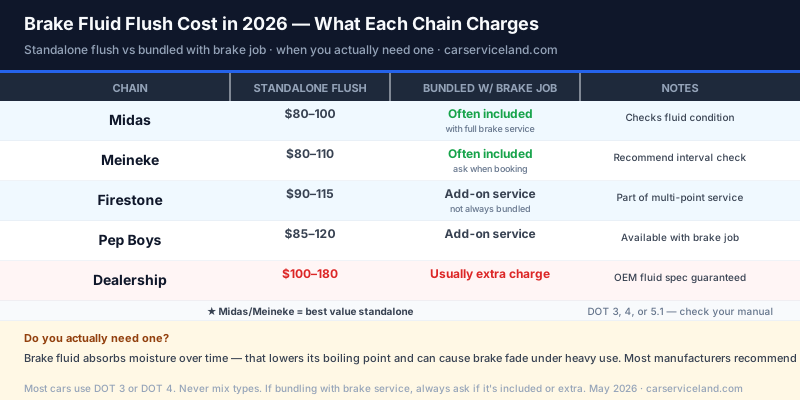
Brake fluid flush typically costs $80-$150 at major chains. Firestone runs $90-$120 as a standalone service. Pep Boys doesn’t post a standalone price at all – it’s bundled into the $249-per-axle Premium brake package. Midas and Meineke quote it after inspection, usually landing in the $80-$110 range. Most manufacturers recommend a flush every two years or 30,000 miles, whichever comes first.
This is one of the most overlooked maintenance items in the entire car service category, and I understand why – there’s no noise, no warning light in most cases, no obvious symptom until it becomes a real problem. Unlike squealing brake pads, degraded brake fluid announces itself as a slightly softer pedal feel or marginally longer stopping distances. Most drivers don’t catch it without a measurement. A reader who’d had a full brake service done two years prior was surprised when a Firestone tech flagged her brake fluid as degraded at her next oil change. She’d assumed the brake job meant everything brake-related was current. The fluid interval is separate from the pads-and-rotors interval. Worth knowing before it degrades far enough to matter.
How Each Chain Handles Brake Fluid
| Brand | Brake fluid service model | Where it fits |
|---|---|---|
| Firestone | Test-driven exchange – boiling point tested, flush recommended based on condition | Offered as a standalone or alongside brake service |
| Pep Boys | Part of the Premium brake service package ($249 per axle with coupon); also listed separately as a Brake Fluid Exchange package | The bundled price is published – the standalone package has no posted price online |
| Midas | Inspection and estimate model – brake fluid check is part of 55-point inspection | Assessment-led; written estimate covers full job including fluid |
| Meineke | Assessment during brake check – recommended if moisture content is high | 23-point inspection includes fluid condition check |
Why Brake Fluid Degrades
Brake fluid is hygroscopic – it absorbs moisture from the air over time. That moisture lowers the fluid’s boiling point. When brake fluid boils (usually from extended hard braking), it turns to vapor in the lines. Vapor compresses; hydraulic fluid doesn’t. That’s brake fade, and it’s one of the more unpleasant things to discover at 60 mph descending a long hill.
Most manufacturers recommend a brake fluid flush every two years or 30,000 miles, depending on the vehicle. Some drivers go much longer without problems; some drivers in humid climates see faster moisture absorption. Testing the fluid’s boiling point or moisture content is the only reliable way to know.
Firestone’s Test-Driven Approach
Of the chains reviewed, Firestone uses the most explicit test-driven model: the fluid’s boiling point is measured and compared to spec. If the fluid tests below threshold, the flush is recommended. This is the most defensible approach because it ties the recommendation to a measurement rather than mileage alone. Firestone’s brake service pages list brake fluid exchange as a covered service. For how this fits into Firestone’s overall brake pricing and what the full service costs, the Firestone brake quote breakdown has the current details.
Pep Boys’ Package Value
Pep Boys bundles brake fluid exchange into its Premium brake service package. At $249 per axle with coupon (versus $199 for Standard), the fluid exchange is part of what justifies the upgrade. Pep Boys also lists a separate Brake Fluid Exchange Service Package on its site, apart from the brake repair menu – but unlike the Premium bundle, that one doesn’t come with a posted price; you’d need to book an appointment to get a number. If you’re already getting brake service at both axles and your fluid hasn’t been changed in a while, the Premium upgrade price difference can make the fluid exchange essentially free by comparison to getting it done separately elsewhere. For how Midas handles brake fluid as part of its 55-point inspection and written estimate process, the Midas brake quote breakdown covers the full model.
Midas and Meineke: Inspection-First
Both Midas and Meineke check brake fluid condition as part of their respective inspections. Midas’s 55-point process covers fluid; Meineke’s 23-point brake check does the same. If either inspection finds moisture-compromised fluid, the written estimate or repair recommendation will include a flush. The cost will be local – franchise pricing – but you’ll know it’s flagged for a real reason rather than a routine upsell.
What to Ask
If a shop recommends a brake fluid flush, the right follow-up question is: “What did the fluid test at?” A shop that measured the fluid’s boiling point or moisture content can answer that. A shop that recommended it on mileage alone can’t. Both can lead to the right recommendation; but one is based on data and one is based on a schedule. Knowing which is which helps you decide whether to authorize it now or wait for the next service.
What Most Drivers Get Wrong About Brake Fluid Flushes
Skipping it because the brake pedal feels fine. Brake fluid degrades from moisture absorption over time – it absorbs water from the air, and that lowers the fluid’s boiling point. A fresh DOT 3 or DOT 4 fluid boils at well over 400°F. Fluid that’s absorbed moisture over two or three years can boil under sustained heavy braking. You won’t notice until it’s happening: the pedal goes spongy on a long hill, or during repeated stops in heavy traffic. By then you’ve already compromised the braking performance. Most manufacturers recommend a brake fluid flush every two years regardless of brake pedal feel. At $80-$150, it’s cheap insurance against a failure mode that’s invisible until it isn’t. One more thing: if a shop recommends a flush without offering to test the fluid, ask why. A boiling-point test should precede the recommendation – that’s a condition-based call, not a mileage-schedule upsell. Also, a “fluid check and top-off” during an oil change is not the same as a flush. Top-off adds volume; a flush replaces contaminated fluid throughout the entire system. These are not interchangeable services.
Jake’s Take
Brake fluid flush is one of the most commonly upsold services at chain shops, and also one of the most legitimately necessary ones on vehicles that have skipped it. The test strip is the only honest answer: brake fluid absorbs moisture over time, and the strip tells you the moisture percentage objectively. If a tech recommends a flush without offering to test the fluid, ask why. A $15 strip test before a $100 flush is reasonable. At shops offering the test, $70-$100 for a flush is fair. If someone’s quoting you over $150 without a compelling reason, get a second quote.
Frequently Asked Questions
How much does a brake fluid flush cost?
Brake fluid flush pricing varies by chain and location. Pep Boys bundles it into the Premium brake package ($249 per axle with coupon) – it does list a separate Brake Fluid Exchange package, but with no posted price. At Firestone, Midas, and Meineke, it’s priced separately as a standalone service or rolled into a broader brake repair estimate, typically $80 to $120 – local franchise pricing means the exact number varies.
Do I need a brake fluid flush every year?
Most manufacturers suggest every two years or 30,000 miles. Driving conditions matter: heavy towing, mountain driving, or humid climates accelerate moisture absorption. Testing the fluid is more reliable than relying on the calendar alone.
Is brake fluid flush the same as a brake fluid top-off?
No. A top-off adds fresh fluid to bring the reservoir to the correct level – it doesn’t remove or replace the degraded fluid already in the system. A flush exchanges the old fluid with new fluid throughout the lines, calipers, and master cylinder. Those are different services with different purposes.
Can I do a brake fluid flush myself to save money?
Yes, it’s a DIY-feasible service for someone comfortable with basic car maintenance. The process involves bleeding the brake system from each wheel cylinder or caliper until the fluid runs clear and fresh. You need a brake bleeder or a helper, the right fluid for your vehicle (DOT 3, DOT 4, or DOT 5.1 – never mix types), and a basic hand pump or pressure bleeder. Total parts cost is $15-$40. The catch: getting all the air out of the lines matters significantly for brake system performance. Incomplete bleeding can leave soft spots in pedal feel. If you’re not confident in the procedure, the shop-done flush at $80-$130 is probably the right call – it’s a safety-critical system and the professional labor rate is justified here in a way it isn’t for, say, a cabin air filter swap.
How do I know if my brake fluid needs to be flushed before going to a shop?
Two ways to check without going to a shop: the fluid’s color and a test strip. Fresh brake fluid is clear to light yellow. Dark brown or black fluid has significant age and contamination and almost certainly needs replacement. Test strips for brake fluid moisture content are available at auto parts stores for a few dollars – they change color based on copper content (which increases with moisture exposure). Neither method gives you the boiling point measurement a shop can do, but both are useful pre-appointment checks. If the fluid looks like old coffee, you don’t need a test to know it’s due.
Which chains offer brake fluid flush as part of a brake service package?
Firestone, Midas, and Meineke all offer brake fluid flush as a standalone service, and will sometimes bundle it in when you’re already getting brake pad or rotor work done. Pep Boys is the exception – its brake fluid exchange is built into the Premium brake package ($249 per axle with coupon) rather than sold as its own line item with a posted price. None of these chains automatically includes a flush in a basic brake job; it’s usually offered as an add-on once the inspection or test shows it’s needed. If you’ve been told you need a brake fluid flush alongside pads and rotors, that’s not unreasonable – the two services make sense together because brake work involves opening the hydraulic system anyway. The price bundled with brake service is usually better than scheduling a flush on its own. Quick-lube chains (Jiffy Lube, Valvoline) don’t generally perform brake fluid flushes – that’s a full-service shop service.
What brake fluid type should I use – DOT 3, DOT 4, or DOT 5.1?
Use whatever your owner’s manual specifies – not what’s on the shelf at the nearest auto parts store. Most domestic vehicles use DOT 3 or DOT 4, which are glycol-based and compatible with each other (DOT 4 can be used where DOT 3 is specified, but not vice versa). DOT 5 is silicone-based, does not absorb moisture like glycol fluids, and is incompatible with DOT 3 and DOT 4 – never mix them. DOT 5.1 is a high-performance glycol fluid, not to be confused with DOT 5. Most European performance vehicles spec DOT 4 or DOT 5.1. When the shop does a flush, confirm they’re using the correct spec for your vehicle – a shop that uses DOT 3 in a car that requires DOT 4 is technically within compatibility but not meeting the vehicle spec.
Sources
Service model and pricing information from official brake and fluid-exchange pages at Firestone, Pep Boys, Midas, and Meineke, re-verified June 2026.

About the Author
Jake Morrison
Jake spent three years in the service bay at a Jiffy Lube in Garland, Texas before switching to automotive writing. He’s had brake work done at Firestone, Midas, and Meineke – and once drove nearly 4,000 miles on a car with a toe misalignment before a tech caught the uneven wear at a routine oil change. His 2021 RAM 1500 5.7L Hemi keeps him well-acquainted with what brake and alignment service actually costs. At carserviceland.com he covers what the major chains charge versus what they advertise.