 Car Service Land Coupons for Oil change, Tires, Wheel alignment, Brakes, Maintenance
Last updated: June 22, 2026 | By: Jake Morrison
June 2026 update: re-confirmed the pad-and-rotor price ranges used throughout this page and expanded one of the FAQ answers with more pricing detail.
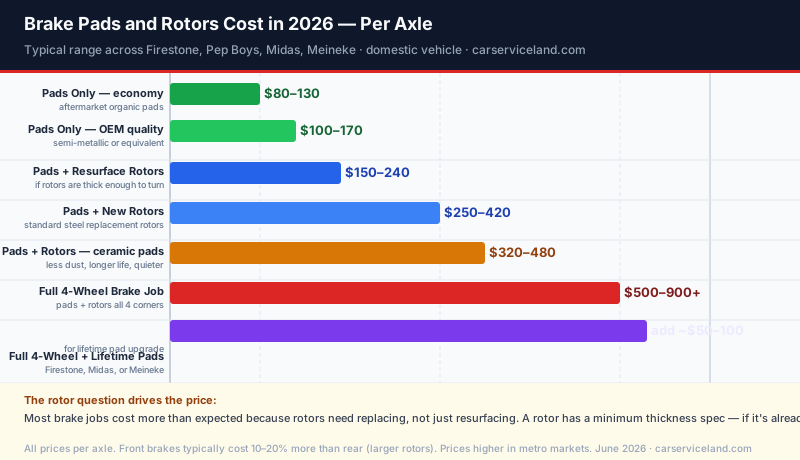
Brake pads only: $150-$280 per axle. Pads plus rotors: $300-$500+ per axle. The difference is entirely whether your rotors are in spec for resurfacing or have worn below minimum thickness and need replacement. That determination happens at inspection – which is why going in with a specific price expectation before the tech looks at the hardware is risky.
Rotor condition is the biggest swing variable in the brake service category, and I’ve seen it surprise people in both directions. Some customers expecting a $400+ job find out the rotors still have life and pay $180. Others expecting a $180 pad swap find out the rotors are scored past the spec limit and the job triples. The inspection isn’t a delay tactic – it’s the only honest way to quote brake work. A tech who quotes the full job without looking at the rotors first is either assuming the worst (and may be overquoting) or guessing. Neither serves you. The inspection-first chains (Midas, Meineke, Firestone) are more honest about this than any shop that hands you a flat price over the phone.
The Three Jobs That Look Like “Brake Service”
When most people say “I need a brake job,” they’re describing one of three different actual repairs:
Pads only (with rotor resurfacing): The pads are worn; the rotors are thick enough to be machined flat and reused. This is the least expensive scenario. Pep Boys’ Standard package is built around this – new pads, rotor resurfacing where applicable. Firestone’s standard offer covers this scope.
Pads with partial rotor work: One axle needs pad replacement; the other also needs rotors resurfaced or even replaced. The per-axle cost starts stacking. This is where “up to $100 off” coupons become less meaningful – the total is higher, the coupon covers part of it, and the remaining balance can still surprise you.
Pads plus rotor replacement: Rotors have been machined before (most have a limit of one resurface), or they’re at or below minimum thickness. New rotors go on instead. This is the most expensive common brake scenario, and it’s also the most common outcome if the car has been driven past the point where pad replacement would have been enough.
Why Rotor Condition Is the Biggest Price Lever
Rotors have a minimum thickness specification, usually stamped on the rotor itself or listed in the vehicle service manual. Once a rotor is machined below that minimum – whether because it was resurfaced once too many times or because it wore down from long service – it can’t be reused. The technician has no choice but to replace it.
That’s not an upsell. It’s a safety requirement. A rotor below minimum thickness has reduced heat mass, which means it absorbs less braking energy before it starts warping or cracking. I’ve seen what warped rotors do to a brake job that looked fine on paper – it’s not a risk worth taking to save a hundred bucks. For how Firestone handles rotor replacement costs in the context of their coupon – where rotors are explicitly separate from the discount – the what Firestone charges for brakes breaks down the full pricing structure.
Current Price Signals by Chain
| Brand | Pads-only signal | Rotor work included? | Notes |
|---|---|---|---|
| Pep Boys Standard | $199 per axle with coupon | Resurfacing where applicable | Replacement rotors extra |
| Pep Boys Premium | $249 per axle with coupon | Resurfacing where applicable | Adds fluid exchange; replacement rotors still extra |
| Firestone | Up to $100 off standard brake service | Resurfacing or replacement as needed | Rotors and drums excluded from coupon |
| Midas | 55-point inspection + up to $100 off | Inspection defines scope; estimate covers full job | Local pricing; written estimate before any work |
| Meineke | Free check + $100 off pads/shoes locally | Scope defined by free brake check | Rotor replacement separate from pad coupon |
What to Ask About Rotors Before You Approve the Job
Any time you’re getting brake pads replaced, ask the shop to measure the rotor thickness before they machine or replace anything. That measurement tells you what you’re actually dealing with. If the rotor is well above minimum thickness, resurfacing makes sense. If it’s close to minimum, replacement now is cheaper than coming back in six months.
You can also ask if the shop shows you the measurements. Good shops do this as a matter of course – it’s the difference between being told “your rotors are fine” and being shown the number that proves it. For a comparison of how Midas and Meineke both handle this measurement step differently, the Midas vs Meineke brake service guide covers both inspection processes.
What Most Drivers Get Wrong About Brake Pads and Rotors Cost
People treat the pad and rotor question as separate line items and try to minimize by doing pads now and “seeing about rotors later.” That logic works when the rotors are actually fine – but if they’re borderline now and you put new pads on them without resurfacing, the rotors continue to wear unevenly and you may be back in 15,000 miles with rotors that now need replacement instead of the resurfacing they could have gotten during the first visit. The combined job at one visit usually costs less than two separate visits. Labor for removing the calipers and wheels is the same whether you’re doing pads only or pads plus rotor work. If the inspection shows the rotors are anywhere near minimum thickness, doing the full job now is almost always the cheaper path over 12-18 months. For what coupons cover – and crucially, which ones exclude rotor work – the brake coupon page explains each chain’s terms clearly.
The other thing drivers miss: rotor replacement costs vary significantly by vehicle. A standard domestic sedan might see replacement rotors at $40-$70 each at a parts store. A larger truck or European import can run $80-$160 per rotor. When a shop quotes you $500+ for a brake job, a meaningful chunk of that may be part cost, not labor. Understanding what your vehicle’s specific rotors cost before the inspection helps you evaluate whether a repair quote is in the right neighborhood. For how Pep Boys handles rotor pricing within their published package structure, the Pep Boys brake pricing details has the current per-axle numbers.
Jake’s Take
Expect $300-$500 or more per axle for pads and rotors at a chain shop on a mainstream vehicle, before coupons. The spread is that wide because rotor cost varies significantly by vehicle – budget sedans land toward the bottom of that range, trucks and SUVs push toward the top or past it just in parts. My RAM 1500 rear brake jobs cost more than most cars simply because of parts. Know your vehicle type going in and ask for a parts breakdown, not just a total. A quote of “$350 for brakes” tells you nothing; “$180 labor + $75 pads + $95 rotors, rear axle” tells you everything. Always ask for the breakdown.
Frequently Asked Questions
Is it worth replacing brake pads without replacing rotors?
Yes, if the rotors measure above minimum thickness and have no damage. Resurfacing is typically included in the service cost. If rotors are at or near minimum thickness, replacing them at the same time saves labor – the wheels and calipers are already off the car.
Do all brake service coupons cover rotors?
Most don’t. Firestone’s standard brake coupon explicitly excludes rotors and drums. Pep Boys’ packages include rotor resurfacing where applicable but not replacement. Midas and Meineke coupons apply to the brake service total – so rotor replacement would be included in the estimate the coupon discounts.
How long do rotors last compared to brake pads?
Pads typically last 30,000-70,000 miles depending on driving habits and pad material. Rotors often last through two pad changes before needing replacement – but heat cycling, hard braking, and driving patterns all vary that significantly. On a vehicle averaging 12,000 miles a year, that puts most rotors somewhere in the 60,000-140,000-mile range before they’re a real candidate for replacement instead of resurfacing. Stop-and-go city driving or frequent towing can cut that range by half or more. Inspection is the only reliable answer for any specific vehicle.
How do I know if a brake quote includes rotor replacement or just resurfacing?
Ask the shop directly and in specific terms: “Does this quote include rotor resurfacing, rotor replacement, or are the rotors not being touched?” Get the answer in writing on the estimate. At Pep Boys, Standard service includes resurfacing where applicable – if the rotors can’t be resurfaced, replacement rotors are an add-on line item. At Firestone, the standard coupon excludes rotors and drums; any rotor work is priced separately. At Midas and Meineke, the written estimate after inspection will specify whether rotors are being resurfaced or replaced and at what cost. “Brake service” is not a complete description of the job – the rotor treatment is the variable that can change the price by $100-$300 per axle. If the estimate doesn’t specify, ask before signing anything.
Can I source my own rotors and bring them to a shop for installation?
Yes, some independent shops will install customer-supplied parts. Most major chains – Firestone, Pep Boys, Midas, Meineke – use their own parts and won’t install customer-supplied rotors as standard practice. If you want to supply your own rotors, an independent mechanic is the more likely path. The catch: most shops that do this charge more for labor when they’re installing your parts rather than their own (since warranty claims on parts go back to you rather than their supplier), and they won’t warranty the repair in the same way. For most drivers, buying rotors and parts coordination is more complexity than the parts savings justify. For a driver with a higher-spec vehicle who wants specific rotor quality, the supply-your-own approach at a trusted independent shop can work well.
What are the warning signs that rotors need replacement rather than just resurfacing?
There are four signals worth paying attention to. First: rotor thickness below the minimum spec. Every rotor has a minimum discard thickness stamped on the edge or hub – if the rotor is at or below that number, resurfacing removes more material and makes it unsafe. Second: deep grooves or score marks on the rotor face, typically caused by metal-to-metal contact after pads wore completely through. A rotor with significant scoring can’t be machined back to smooth without going below spec. Third: visible cracking or heat spots (blue coloring indicating localized overheating). These are structural issues resurfacing can’t fix. Fourth: rotor run-out above 0.003 inches – measured with a dial indicator – that causes brake pedal pulsation and can’t be fully corrected by resurfacing alone. Any shop doing a proper brake inspection will measure these and show you the results.
Do drilled and slotted rotors last as long as standard rotors?
Not usually – and for most daily drivers, the trade-off isn’t worth it. Drilled and slotted rotors dissipate heat better under hard braking, which is why they’re popular on performance and tow vehicles. But the holes and slots create stress concentration points, and under repeated thermal cycling (everyday stop-and-go driving), those points can develop micro-cracks over time. Standard blanks rotors simply have more material and last longer in normal use. For a vehicle that sees occasional track days or tows regularly in mountainous terrain, the performance advantage is real. For a daily commuter, standard smooth rotors are cheaper, last longer, and perform identically under normal stopping conditions.
Sources
Pricing and service model information from official brake pages at Pep Boys, Firestone, Midas, and Meineke, June 2026.

About the Author
Jake Morrison
Jake spent three years in the service bay at a Jiffy Lube in Garland, Texas before switching to automotive writing. He’s had brake work done at Firestone, Midas, and Meineke – and once drove nearly 4,000 miles on a car with a toe misalignment before a tech caught the uneven wear at a routine oil change. His 2021 RAM 1500 5.7L Hemi keeps him well-acquainted with what brake and alignment service actually costs. At carserviceland.com he covers what the major chains charge versus what they advertise.