 Car Service Land Coupons for Oil change, Tires, Wheel alignment, Brakes, Maintenance
Last updated: June 22, 2026 | By: Jake Morrison
June 2026 update: re-confirmed the typical independent-shop labor fee for bring-your-own-oil changes and narrowed the chart to the chains this guide actually covers.
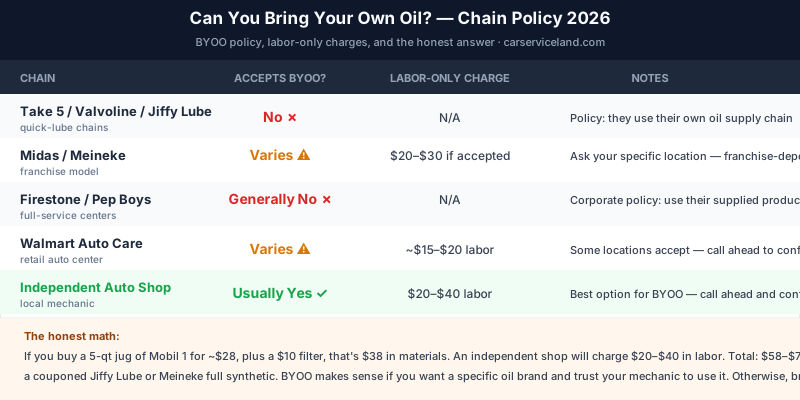
Most major chains won’t do it – Jiffy Lube, Valvoline, and Take 5 typically decline. Independent shops are more flexible. Walmart and Pep Boys vary by location. The only reliable way to know: call ahead before you show up with a jug of Mobil 1 in your trunk.
I’ve seen this situation go badly more times than it should. Someone buys the premium oil their dealer recommends, drives across town to their usual quick-lube chain, and gets turned away at the bay because the chain’s service model doesn’t accommodate customer-supplied product. It’s not unreasonable from the shop’s side – they build their labor pricing around supplying the oil themselves. But it’s an irritating waste of a trip. One reader in suburban Dallas told me he’d called three locations before finding an independent shop that would use his oil and filter. That’s the experience you avoid by calling ahead. The 90 seconds it takes to confirm is a simple trade for not wasting a Saturday morning.
What Major Chains Actually Say About It
| Chain | How the service is packaged | Bring-your-own implication |
|---|---|---|
| Jiffy Lube | Signature Service includes oil, filter, and inspection as one package | Package-first model – customer-supplied oil not the default |
| Walmart | Oil changes sold as complete service packages including oil and filter | Retail packaged model |
| Pep Boys | Packages include up to 5 quarts and new filter; technicians install manufacturer-recommended oil | Varies by location – some will work with spec-compliant customer oil, others won’t; call ahead |
| Midas | Official pages say they won’t put oil in your vehicle that fails manufacturer specs | Spec requirement may conflict with customer-supplied oil verification |
None of these say an explicit universal “no.” But the subtext is clear: the standard service workflow at major chains is built around the shop providing the oil and filter. Bringing your own isn’t forbidden, but it’s not the expected customer behavior either.
Why Some Shops Say No
Liability is the main reason. If you bring in the wrong oil – wrong viscosity, wrong spec, wrong type for your engine – and the shop installs it, the resulting damage creates a complicated question about who’s responsible. Most shops aren’t willing to take that risk without charging more for the inconvenience or refusing outright.
Warranty and guarantee structures are another factor. A shop that guarantees its service typically ties that guarantee to the products it supplies. Using your oil means their guarantee doesn’t apply to the oil, which partially defeats the purpose of using a shop in the first place. If you’re choosing an oil type for your vehicle anyway, the synthetic vs conventional oil change price guide covers what each costs at major chains.
When It Can Work
It’s more common at independent shops than at standardized national chains. An independent mechanic who has a relationship with you and knows your car may be happy to install oil you supply – they’ll charge a labor or service fee, but they’ll work with you. That’s a legitimate arrangement that happens all the time.
At a national chain, the best path is to call ahead, ask directly, confirm what the labor charge would be without their oil, and confirm whether any service guarantee changes. If they’re willing and the terms make sense, go for it. If they’re not, that’s a real answer too.
Does Bringing Your Own Oil Actually Save Money?
Sometimes, but usually less than people expect. If you bring your own oil, the shop still charges a service fee and labor. At most chains, the all-in cost of providing your own synthetic is often within $5-$15 of what they’d charge for the same tier from their stock. The savings are real but modest, and they come with the hassle of purchasing and transporting oil yourself.
Where it can make more sense: very large-displacement engines that need 7-8 quarts (like my RAM 1500 with its 8-quart requirement), where buying your own synthetic in bulk is meaningfully cheaper than the per-quart upcharge shops apply to those extra quarts. The full synthetic price guide shows what major chains currently charge per visit, including how extra-quart pricing stacks up.
The Right Way to Do It
- Call the shop before you go – don’t just show up with a bottle and expect it to work.
- Ask whether they accept customer-supplied oil, and what the labor charge will be.
- Confirm whether you should also bring your own filter.
- Ask whether any service warranty or guarantee changes when they use customer-supplied materials.
- Bring the exact correct viscosity and API specification for your vehicle – check the owner’s manual, not just the top of the dipstick tube.
What Most Drivers Get Wrong About Bringing Their Own Oil
Two assumptions cause the most friction. First: that the savings are substantial. They usually aren’t. The shop charges a service fee whether you bring the oil or they supply it. The labor is the same. The net savings on most passenger vehicles is $5-$15 in the best case – real money, but not the dramatic discount people imagine. Where it actually makes sense is on high-capacity engines. My RAM 1500 takes 8 quarts. At a shop that charges $4-$6 per quart for the three quarts above the standard 5-quart package, buying a full jug of synthetic and bringing it shaves off $12-$18 in overage charges. That’s a real number. For a 4.8-quart Civic, the math doesn’t move much.
Second assumption: that you can just show up. You cannot. Every major chain’s service model is built around supplying the oil themselves – that’s how they structure the package price and guarantee. Calling ahead isn’t a formality; it’s how you find out whether the shop will even accommodate it before you drive over with a jug in your back seat. When you’re ready to book and let the shop supply the oil, the full price breakdown shows current pricing by chain.
Jake’s Take
Technically yes at most shops – practically, almost nobody does it and the math usually doesn’t work out. Quick-lube chains like Jiffy Lube and Valvoline won’t let you supply your own oil because their whole pricing model is built on the service package. Independent shops will often allow it but charge a labor fee that erases whatever you saved buying oil at Costco. The cases where it makes sense: a specialty oil your vehicle requires that the shop doesn’t stock (certain European or diesel specs), or a shop you trust that is flexible on labor rates. Call ahead before showing up with a jug – most shops will tell you their policy in 30 seconds.
Frequently Asked Questions
Do major chains allow customers to bring their own oil?
Not as a standard practice. Most large chains operate on packaged service models. Whether a specific location will accommodate it depends on that shop – call first.
Can bringing your own oil save money?
Modestly, sometimes. The shop still charges labor/service fees, so the net savings are usually less impressive than people expect. The clearest savings come from vehicles with high oil capacity where buying synthetic in bulk makes sense.
Is it safe to bring your own oil?
If the oil meets your vehicle’s exact specifications (viscosity, API rating, OEM approval), yes. If there’s any uncertainty about the spec, let the shop supply the oil – they know what’s compatible and they take responsibility for it. For advice on how frequently you should be coming in at all, the how often should you change your oil guide covers the modern intervals by oil type.
Do independent shops charge more to install customer-supplied oil?
Many charge a small “shop supply” or “BYOO” labor fee – typically $10-$25 – compared to their standard service rate. The logic is they still put a tech under the car, generate a work order, and dispose of your old oil. Those costs don’t disappear just because you brought the lubricant. Some shops waive this for established customers. Call ahead and ask directly: “What’s your labor charge if I supply my own oil and filter?” Most honest shops give you a straight answer.
Does using your own oil affect the service warranty or guarantee?
Often yes. Chain warranties typically cover the entire service, including the products they supplied. A typical workmanship guarantee at a major chain runs 12 months or 12,000 miles, and that coverage usually shrinks the moment you bring your own oil – most chains will still stand behind their labor but exclude anything traced back to the oil itself. Get this in writing or verbally confirmed before authorizing the work. If a shop can’t tell you clearly what changes when you supply your own materials, that’s a signal to use their oil or find a different shop.
Can I bring my own filter as well as my own oil to an oil change chain?
Bringing your own filter is even harder than bringing your own oil. Most chains specifically decline customer-supplied filters because the filter is part of their service guarantee – if a customer’s filter fails, the chain can’t warranty the work. Jiffy Lube, Valvoline, and most others will tell you upfront: they install their own filters only. If you have a specific filter brand preference (some people prefer Wix, K&N, or OEM-spec filters for their vehicle), doing your own oil change or using an independent shop that accommodates this is the cleaner path than trying to negotiate with a chain.
What happens if I bring my own oil and something goes wrong with the engine?
This is the core risk of bringing customer-supplied oil: warranty liability. If you supply the oil and the engine later develops a problem related to lubrication, the chain can and likely will disclaim responsibility. On the other hand, if the chain accepts your oil, performs the change correctly, and something else goes wrong – a wrong drain plug torque, a filter seal issue – they’re still responsible for their own work, typically under the same 12-month/12,000-mile labor guarantee they’d offer on any oil change. The liability risk is mostly around whether the oil itself is appropriate for your vehicle and genuine (not counterfeit or degraded) – a real engine problem from bad or wrong-spec oil is a $3,000-$8,000 repair, not a warranty claim, if the shop can show it wasn’t their oil. For this reason, most chains don’t take the risk and simply decline customer-supplied oil altogether.
Sources
Service model information from official chain pages, June 2026.

About the Author
Jake Morrison
Jake spent three years working the pit at a Jiffy Lube in Garland, Texas – which means he’s seen every oil change upsell in the book and knows exactly which ones are legitimate. His 2021 RAM 1500 5.7L Hemi takes 8 quarts of full synthetic, so he’s personally acquainted with how fast an advertised price can balloon at checkout. At carserviceland.com he tracks what chains actually post versus what drivers actually pay.