 Car Service Land Coupons for Oil change, Tires, Wheel alignment, Brakes, Maintenance
Last updated: June 22, 2026 | By: Jake Morrison
June 2026 update: refreshed the Firestone coupon reference and confirmed that Pep Boys’ synthetic-vs-conventional price gap runs wider than at other chains.
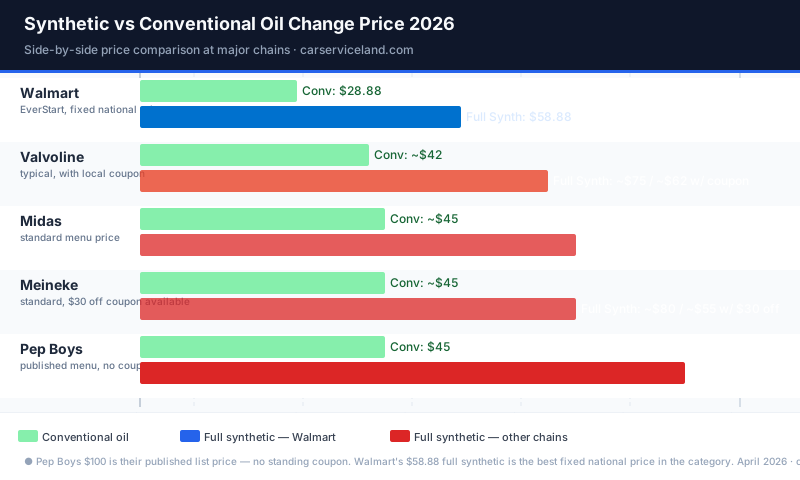
Synthetic oil changes typically cost $25 to $55 more than conventional, depending on the chain – there’s no single number that holds everywhere. But if your vehicle requires synthetic, that higher price isn’t a choice. Most cars built after 2010 specify synthetic. Conventional is only the right option for older vehicles whose owner’s manual calls for it.
Quick verdict: Choose full synthetic if your manual requires it, you drive in extreme heat or cold, or you tow regularly – the longer interval usually pays for the higher price. Choose conventional if your manual allows it, your car is older, and you’re not pushing it hard. For most vehicles built in the last 10-15 years, the manual has already made this decision for you.
The mistake I see regularly when people write in: they chose conventional to save money on a 2016 or newer vehicle, then wonder why the service interval is shorter or why the shop won’t warranty the work. Conventional oil in an engine designed for synthetic doesn’t last as long between changes, and you may end up changing it more frequently – potentially erasing the savings. One reader with a 2015 Subaru Forester switched back to synthetic after his conventional-oil changes were being flagged at 3,500 miles instead of 7,500. At $30 savings per visit but twice the frequency, he was actually paying more annually for the cheaper oil.
For a direct comparison of the type-specific angles on this topic, see synthetic blend pricing and synthetic oil price breakdown. This page covers the head-to-head cost difference between the two endpoints.
Current Price Comparison: Synthetic vs Conventional
| Chain | Conventional price | Synthetic blend price | Full synthetic price |
|---|---|---|---|
| Walmart | $28.88 (Pit Crew) / $36.88-$38.88 (standard) | ~$49.88 | $58.88-$64.88 |
| Pep Boys | $45.00 | $78.00 (high mileage blend) | $100.00 |
| Midas | $19.99-$39.99 (local) | $24.99-$49.99 (local) | $59.99-$79.99 (local) |
| Firestone | ~$29.99 (typical, no fixed national price) | $15 off any oil change (current coupon) | $15 off any oil change (current coupon) |
Prices from official chain pages and sample local store pages, June 2026.
Why Synthetic Costs More
Synthetic oil is engineered at a molecular level rather than refined from crude oil. It has a more uniform structure, breaks down more slowly under heat, and maintains its viscosity across a wider temperature range. You’re not paying for a marketing upgrade – you’re paying for a fundamentally different lubricant that does a different job under harder conditions.
That difference translates to stronger engine protection, better cold-start performance, and in many modern vehicles, a significantly longer service interval. Some manufacturers now set oil change intervals at 7,500-15,000 miles specifically because they assume you’re running full synthetic. For a chain-by-chain price comparison covering all oil types, the what major chains charge has the current numbers in one place.
When Synthetic Is Worth the Extra Cost
Honestly – for most people buying a car in the last 10-15 years, synthetic is already what your car requires. You’re not choosing between synthetic and conventional; your owner’s manual has already made that decision.
But setting aside required applications, synthetic makes financial sense when:
- You drive in extreme temperatures – hot Texas summers or cold Minnesota winters both degrade conventional oil faster.
- You tow or haul regularly. Pulling a trailer stresses an engine in ways that conventional oil wasn’t designed for under extended use.
- The extended interval logic works in your favor. If full synthetic lets you go 7,500 miles between changes instead of 3,000-5,000, you’re paying more per visit but fewer visits per year. The math can favor synthetic even when the price is higher.
When Conventional Is Still the Right Call
For older vehicles that predate widespread synthetic adoption, conventional oil often makes perfect sense. An early-2000s car with 120,000 miles and no oil-consumption issues, driven mostly around town – that car doesn’t need $65 full synthetic every visit. Conventional at $29 every 3,000-5,000 miles is the correct, cost-effective answer.
The key phrase is “if your manual allows it.” That qualifier is everything. If the manual says conventional is acceptable, it is. If the manual says full synthetic only, there’s no legitimate conventional shortcut. For current conventional oil change prices by chain, the conventional oil change price guide has the numbers.
The Interval Math People Miss
This is the calculation most drivers skip when they complain about synthetic price. If conventional costs $35 and you need it every 3,000 miles, that’s $35 every 3,000 miles. If full synthetic costs $65 and you can go 7,500 miles between changes, the per-mile cost of synthetic is actually lower. Over 15,000 miles: five conventional changes at $35 = $175 vs. two synthetic changes at $65 = $130.
The higher price per visit doesn’t automatically mean higher annual cost. For the manufacturer-recommended intervals by oil type and vehicle, the how often should you change your oil guide has the specifics.
What Most Drivers Get Wrong When Comparing Synthetic vs Conventional Price
The per-visit price is what people compare, and it’s the wrong number. A $35 conventional change vs a $65 full synthetic change looks like a $30 savings. But if the conventional interval is 3,500 miles and the synthetic interval is 7,500 miles, you’re paying $35 four or five times per year vs $65 twice. That math flips. Over 15,000 miles: five conventional visits cost $175. Two synthetic visits cost $130. The cheaper oil actually cost more.
I walked a reader through this after he wrote in to complain that I was recommending “the expensive option.” He drove about 15,000 miles a year in a 2019 Silverado. Once we ran the actual numbers, he was spending $40 more per year on conventional oil in a truck that didn’t even call for it. The lesson: price per visit is a bad unit. Price per year, or price per mile, is the comparison that actually matters. If you’re trying to find the best deal right now, the best current oil change offer tracks what’s currently active across all major chains.
Jake’s Take
Check your owner’s manual before you touch anything else. If it says full synthetic, that’s not a suggestion – that’s the spec, and using conventional voids the logic of the service interval. My RAM 1500 5.7L Hemi requires full synthetic; I learned the hard way that “close enough” isn’t good enough on a high-compression engine. The price gap between synthetic and conventional is real – anywhere from $25 to $55 depending on the chain – but on most vehicles the extended drain interval (7,500-10,000 miles vs 3,000-5,000) means the per-mile cost evens out more than people realize. Run the math for your actual situation before deciding it’s not worth it.
Frequently Asked Questions
Is synthetic oil always more expensive?
Yes, per service. Conventional is consistently the lowest-priced tier at every major chain. But per-mile or per-year cost depends on your interval, so the total picture is more nuanced.
Can I use conventional oil if my car takes synthetic?
No – or at least, you shouldn’t. If your manufacturer specifies full synthetic, running conventional oil voids some warranties and shortens the service interval to 3,000 miles or less because the oil degrades faster. It’s not a money-saving move; it’s a liability shift onto you.
What’s the price difference between synthetic and conventional at most shops?
It depends on the chain – there’s no single number that holds everywhere. Typically $20 to $55 more per visit for full synthetic vs conventional. Walmart’s gap runs about $30, Midas falls in the $40-$50 range locally, and Pep Boys has the widest spread at around $55 ($45 conventional to $100 full synthetic on its published menu). Always check your own local store page since prices vary by location and active coupons.
Is synthetic blend a good compromise?
For vehicles that allow it – yes. Synthetic blend runs $10-$30 more than conventional but noticeably less than full synthetic, and it provides better protection than conventional in harder conditions. It’s the right call when full synthetic isn’t required but you want more than the basic tier.
Does running synthetic oil extend the time between oil changes?
Yes – for most vehicles that specify synthetic, the manufacturer’s recommended interval is 7,500-15,000 miles rather than the 3,000-5,000 miles associated with conventional. However, the interval depends on your specific vehicle, driving conditions, and the oil grade recommended. “Drive less, change more” still applies to short trips and severe duty driving even with synthetic. Check your owner’s manual for the actual recommended interval – don’t just assume you can go to 10,000 miles because a friend with a different car does.
If I switched from synthetic to conventional at my last change, is my engine at risk?
Depends on the vehicle. For older cars whose manufacturers approved conventional, no – you haven’t done any harm. For modern vehicles that specify full synthetic (2010+ in many cases), the oil will degrade faster and you’ll need to shorten the change interval – probably to 3,500 miles. More critically, if your warranty specifies full synthetic, running conventional can void coverage on oil-related engine damage. The shop that sold you the conventional change won’t cover the consequence. Check your owner’s manual before your next change to confirm what your car actually requires.
Can mixing synthetic and conventional oil damage my engine?
No – mixing synthetic and conventional oil of the same viscosity doesn’t damage your engine. They’re chemically compatible. What happens is the performance characteristics of the synthetic oil are diluted by the conventional content, and the effective interval of the mixed fill will be shorter than pure synthetic. In an emergency top-off situation, adding conventional to a synthetic fill (or vice versa) is fine – just plan to do a proper oil change sooner than you otherwise would. The old myth that once you switch to synthetic you can never go back to conventional is exactly that: a myth.
Does the price gap between synthetic and conventional close if I factor in change intervals?
Yes, and this is the math most people skip. If you’re paying $35 for a conventional change every 3,000 miles vs $65 for a full synthetic change every 7,500 miles, the per-mile cost on conventional is about $0.0117/mile vs $0.0087/mile on synthetic. Over 30,000 miles, conventional costs ~$350 in oil changes; synthetic costs ~$260. The synthetic oil change is cheaper per mile even though it’s more expensive per visit – and that’s before factoring in the convenience of fewer trips to the shop. The price gap only looks bad at the checkout counter, not over the full year.
Sources
Prices verified against official chain pages, June 2026. Midas and Firestone don’t publish one fixed price nationally, so those figures are local-market typical ranges rather than posted rates.
- Walmart Oil Change Service
- Pep Boys Oil Changes
- Midas Synthetic vs Conventional Oil
- Firestone Complete Auto Care Oil Change Prices
- Jiffy Lube Oil Types

About the Author
Jake Morrison
Jake spent three years working the pit at a Jiffy Lube in Garland, Texas – which means he’s seen every oil change upsell in the book and knows exactly which ones are legitimate. His 2021 RAM 1500 5.7L Hemi takes 8 quarts of full synthetic, so he’s personally acquainted with how fast an advertised price can balloon at checkout. At carserviceland.com he tracks what chains actually post versus what drivers actually pay.